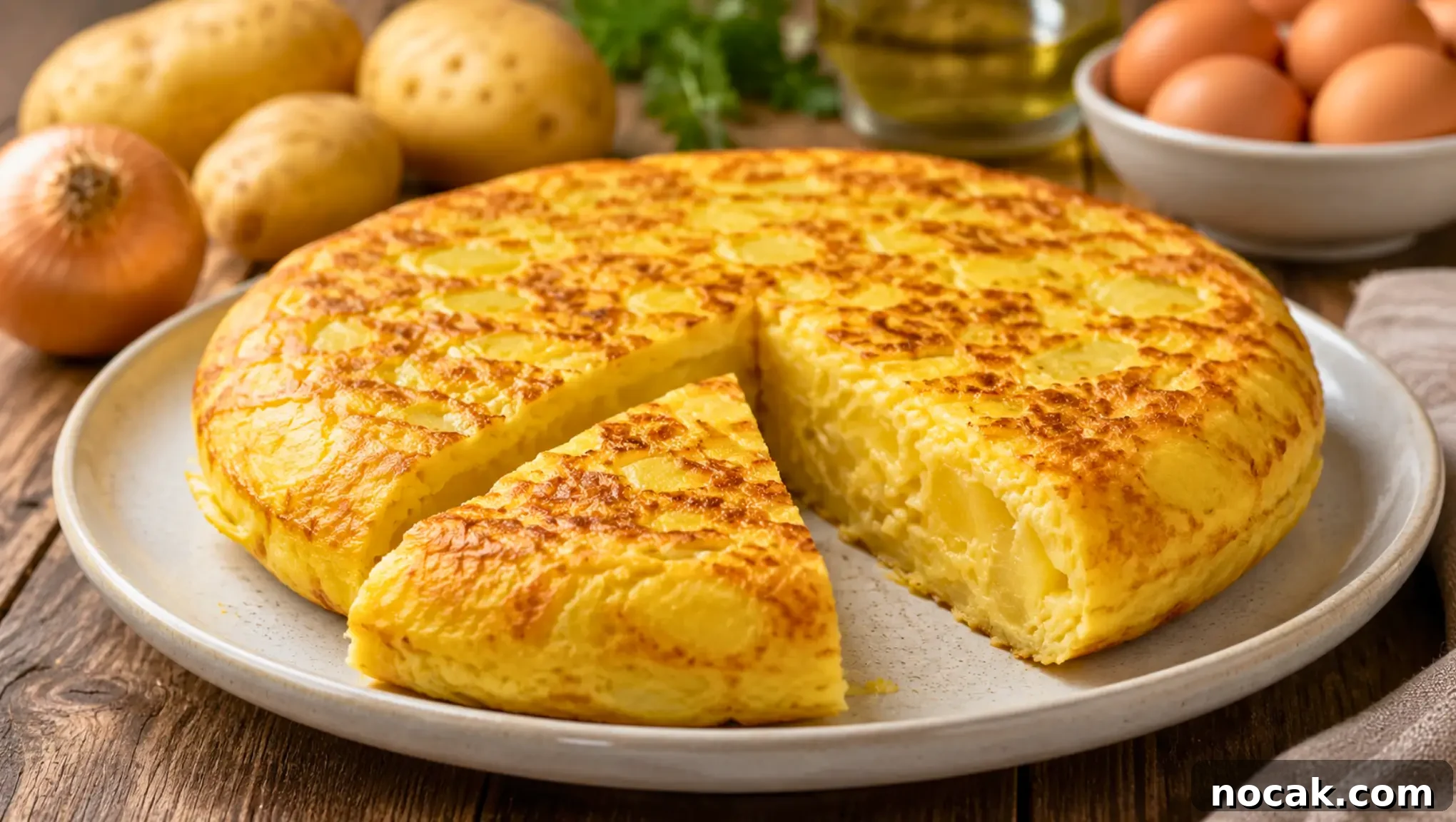
Should you fry or confit the potatoes?
First, a common mistake is to fry the potatoes like french fries over high heat. Professional cooks prefer to confit them gently in a generous amount of olive oil over low heat until they become tender, almost like a confit. Olive oil tolerates prolonged heat well and adds aroma without overpowering the potato, resulting in a soft, yielding texture rather than a hard, overly browned exterior.
For the variety, a floury, low‑moisture potato such as Kennebec performs best and produces a tightly set tortilla. Its lower water content prevents the mixture from becoming soggy during cooking.
With or without onion?
Whether to add onion is a matter of taste. Without onion, the tortilla has a straightforward, clean flavor; with onion, it gains sweetness and juiciness. For those who include it, the key is slow cooking over low heat until the onion reaches a golden brown that brings out its natural sugars without turning bitter. A yellow onion, slightly sweet and thinly sliced, works well and can be confited alongside the potatoes or cooked separately.
The right eggs-to-potatoes ratio, and don’t overbeat
A juicy tortilla depends on the balance between eggs and potatoes. Chefs commonly use about one large egg per 100 g of potatoes, so six to eight eggs for 500 g. Less than this yields a drier result, while too many eggs make the mixture overly wet.
Beat the eggs only enough to combine whites and yolks, avoiding excess foaming. Introducing too much air speeds coagulation during cooking and can dry out the tortilla.
Why let the mixture rest before cooking
After combining the confited potatoes with the beaten eggs, a short 5 to 10 minute rest improves the final texture. During this pause the potatoes absorb some of the egg and the ingredients even out, so the tortilla cooks more uniformly and holds together better when sliced.
This resting period requires no special equipment—just a little patience before the pan—and it also gives you a moment to taste and adjust seasoning before cooking.
Medium heat, salt at the right time, and a good flip
Cooking over medium heat is essential. Too hot and the exterior will brown before the center sets; at medium heat the interior stays creamy while the surface slowly takes on color. A few minutes on each side is usually enough; the final doneness is a matter of preference, from fully set to slightly runny.
Add salt at the appropriate stages—on the potatoes once they’re fried or confited and on the onion once it has softened—not mixed into the beaten eggs. Seasoning can be adjusted at the end. For flipping, a large flat plate placed over the frying pan is the simplest tool; use a nonstick pan about 20 to 24 cm with slightly curved sides for the best results.