This article is part of a series on French idiomatic expressions that relate to food. Browse the list of idioms featured so far.
This week’s idiom is “Ce n’est pas de la tarte.”
Literally translated as “it’s not pie,” this expression means that something is tricky, difficult to do or to handle. As a colloquial spoken phrase, it is commonly contracted to “C’est pas de la tarte.”
Example: “J’essaye de lui faire faire une sieste, mais c’est pas de la tarte !” — “I’m trying to put him down for a nap, but it’s not easy!”
* Note: Une tarte is best translated as “a tart” (a pie without a top crust). The literal translation “it’s not tart” would be confusing in English, so “pie” is used here for clarity.
Listen to the idiom and example read aloud:
(If no player appears, use the provided audio file.)
Although definitive origins are unclear, this idiom appears to be relatively recent, emerging sometime in the second half of the twentieth century.
The phrase can be adapted to other tenses — for example, “Ce n’était pas de la tarte” (it wasn’t easy) or “Ça ne va pas être de la tarte” (it won’t be easy) — but it is always used in the negative to convey difficulty.
To express that something is very easy, French uses a sibling expression: C’est du gâteau — “it’s cake.”
These French expressions naturally recall English counterparts such as “(as) easy as pie” and “a piece of cake,” which date back to the late nineteenth and early twentieth centuries. It’s possible the French sayings were influenced by these English idioms.
Why are baked goods associated with ease? While making tarts or cakes can be challenging, the idioms likely refer to the act of eating them, which most people find effortless and pleasurable.
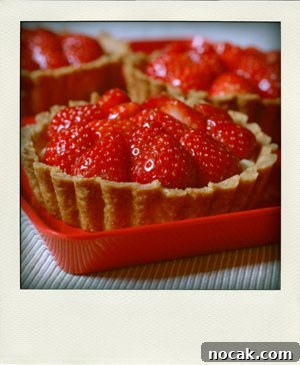
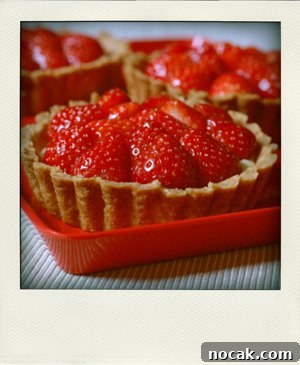
Photo note: The image above shows strawberry tartlets prepared from my mother’s recipe, which is included in my cookbook (available in US, British and French editions).